


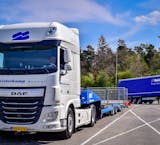


Rick Kruse, Managing Director of the Equipment Division, has been working at Heisterkamp since 2008. During that time, he has seen trailer rental grow from a side activity into a fully fledged pillar of the organization. In this interview, Rick looks back on that development, the lessons learned during times of crisis, and what makes Heisterkamp Equipment so special to him.

When did you start at Heisterkamp and what did your beginning look like?
“I started at Heisterkamp in 2008. Before that, I worked for four years at Transamerica Trailer Leasing, at the time one of the largest trailer rental companies in Europe. There I gained a lot of knowledge about how rental works in the trailer industry.”
“When I joined Heisterkamp, the trailer rental fleet consisted of around 450 trailers and was mainly an extension of the transport activities. Rental customers were often transport customers as well. I started as trailer rental manager, with a focus on sales, but operational responsibilities soon became part of the role too.”
You wanted to grow, but immediately faced the financial crisis. What impact did that have on the department?
“We had plans to expand the fleet and had already placed an order for 150 trailers, the largest order ever at that time. But at the end of 2008 the financial crisis hit. We did take delivery of those trailers, but at the same time many trailers were returned by customers.”
“Instead of building and expanding, it became about stacking trailers and cutting costs. That was a very different start than we had envisioned beforehand and, honestly, it was a tough period.”
How did Equipment continue to grow after that?
“In the beginning, we ran the rental fleet with just the two of us. We quickly started professionalizing the structure and processes, such as implementing a new rental application, digitizing documents, and introducing a check system. That provided structure and oversight.”
“After the crisis, around 2011 and 2012, the transport market picked up again and things moved fast. The numbers grew towards a thousand trailers and soon beyond 1,500 and more. Processes were further optimized, systems improved, and the team grew along with it.”
Where does Heisterkamp Equipment stand today?
“Today, 54 people work within the Equipment division. We have a fleet of around 7,500 trailers, 1,200 trucks, and about 100 terminal tractors. In addition, we have a trading division where we buy and sell around 500 to 650 vehicles annually. That is a world of difference compared to 2008.”
"We have grown in every aspect, but the culture and the family feeling have remained."- Managing Director Equipment Division
What do you think is the reason this growth has been so successful?
“We have followed a deliberate and conservative approach for many years. We avoid unnecessary risks, do not make impulsive investments, and carefully consider every decision. In addition, we distinguish ourselves through a high level of service. We respond quickly, act decisively, and consistently maintain high quality. Once customers start working with us, they usually stay with us for the long term. That says a lot about the trust they place in us.”
Equipment has become broader than just trailer rental. How do you view that development?
“That fits perfectly with our ambition to offer a complete range for the entire transport sector. We want to be able to provide everything a transport company needs. In that sense, we are the ‘supermarket’ of the transport world.”
“Fleet rental already existed before I worked here and was created from the same idea. Within fleet rental, the diversity of trucks has also grown enormously, with terminal tractors being the most recent addition.”
“The used trucks and trailers division originated from the realization that assets coming out of our fleet were previously sold directly to traders. We quickly realized we were missing opportunities there. As a result, we have increasingly grown into a total partner for our customers.”
Which moments really stand out for you?
“There are too many to mention. Every thousand trailers feels like a milestone, and we try to celebrate those successes together. Adding new products to the fleet that are new to us is always a celebration as well.”
“One very concrete moment was in 2012, when we moved to this building at Hanzepoort 25. A prime A-location along the highway. In the past, trucks and trailers were scattered all over the place. Now we look out over the parking area from our office and we are a real eye-catcher from the highway. A dream come true, it doesn’t get any better than that.”
You have been in your current role since 2018. What was the biggest challenge for you?
“I knew the trailer world inside and out, but fleet rental and used trucks are truly completely different disciplines. They involve different types of customers, different equipment, and a very different approach. And in the case of used trucks, even international trade beyond Europe.”

How do you view the professionalization and digitalization of recent years?
“That development has accelerated incredibly fast. Processes, customer and credit approvals, IT, and so on – when you compare how things were done fifteen years ago with how they are organized today, you see that a solid and future-proof structure is now in place.”
“Digitalization plays a major role in this. Where we used to work with paper and pen, we now work with iPads. Data is entered directly into the system, customers are automatically informed, and that not only saves time but also reduces errors and discussions.”
Which lesson from your career do you still carry with you?
“The credit crisis, without a doubt. That was a tough learning experience. Before that, I mainly worked in sales, but during that period the focus shifted to cost control, working more efficiently, and setting up processes.”
“That was the beginning of how we work today: first build a solid foundation, then grow. That way of thinking has stayed with me ever since.”
What makes Heisterkamp Equipment so strong for the future?
“What truly sets us apart is our people. Everyone is motivated and works together toward the same goal. You can feel that the moment you walk into our building.”
“And of course, the cooperation with the other two divisions within our group. This makes us extra flexible when it comes to maintenance and repairs and allows us to switch quickly to get trailers from A to B.”

 Nederlands
 Deutsch
 Español
 Polski
 Română
 Latviešu
 Svenska